Raw Material Warehouses for BOI Companies, Free Zones and Bonded Warehouses in Thailand: Control Imports, Clear the Books and Be Audit-Ready
Factories that import raw materials duty-free, whether under BOI Section 36, in a Free Zone or through a bonded warehouse, must show where every lot went. This guide compares the three regimes, the conditions the warehouse must know, such as the 4-month max stock and the 2-year storage limit, and how a WMS separates stock by privilege, links lots to import declarations and prepares audit data.
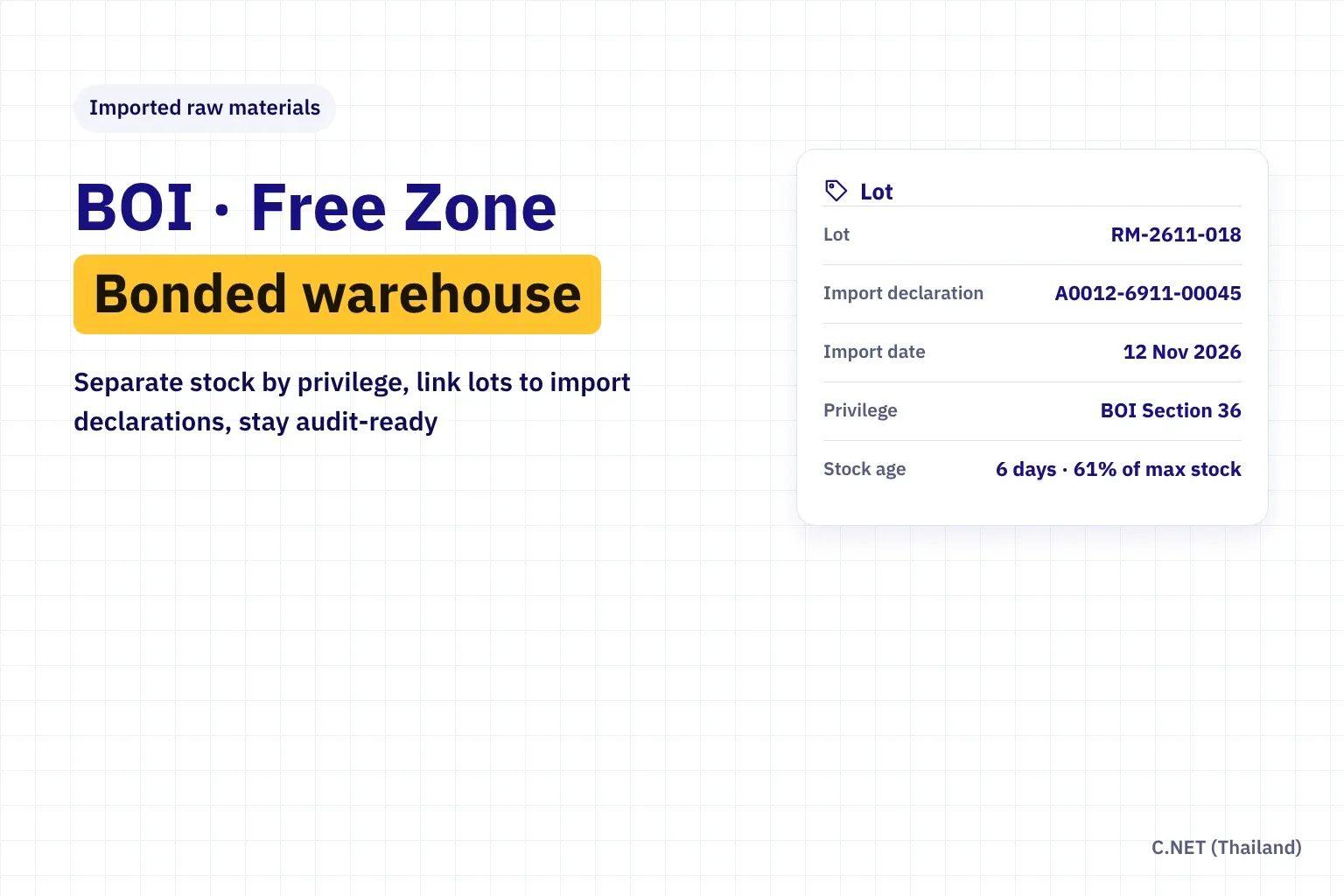
Short answer: BOI Section 36, Free Zones and bonded warehouses all let a factory import raw materials without paying duty up front, in exchange for proving that the goods were used in production and exported, or for paying duty when they enter the domestic market. So the warehouse has the same job under all three: separate stock by privilege, link every lot to its import declaration and import date, record issues to production, waste and destruction, and watch the time limits and stock ceilings each regime sets. A WMS keeps that data in one place and traceable, instead of chasing several spreadsheets when officials arrive.
This summary draws on material published by the BOI, Thai Customs and related bodies as of November 2026, for designing warehouse processes. It is not legal or customs advice. Each company's conditions depend on its own promotion certificate and licences, and rules change: check with the BOI, Customs or your customs broker.
- 4 months
- Maximum stock of Section 36 raw materials, measured against the promoted production capacity
- 2 years
- Storage limit in a Free Zone and in a bonded warehouse from the import date (extensions possible)
- 4 months
- With no stock deduction on a list for this long, the BOI may suspend import releases
- 13 digits
- Tax ID of the buyer to whom deduction rights are transferred on a Report V
How do BOI Section 36, Free Zones and bonded warehouses differ?
| Topic | BOI Section 36 | Free Zone | Bonded warehouse |
|---|---|---|---|
| Regulator | Board of Investment (BOI); stock deduction through RMTS | Thai Customs (zones designated by the Director-General) | Thai Customs (warehouse licence) |
| Main benefit | Import duty exemption on raw materials used for export products | No import duties and taxes on goods brought into the zone for industrial or commercial operations | No duty while stored; duty due when goods leave for domestic sale |
| Time / quantity limits | Max stock up to 4 months of capacity; deductions must keep flowing | 2 years from first deposit (machinery excluded), extendable | Up to 2 years from import, renewable |
| What must be proven | Materials used per production formula, and actually exported | Goods into and out of the zone, and use in production | Balance on hand, goods removed, and each movement in and out |
BOI Section 36: promoted companies receive import duty exemption on raw and essential materials used to make export products under Section 36(1); Section 30 gives a duty reduction for products sold domestically (Investor Club (IC)). The privilege is administered through RMTS (Raw Material Tracking System), run by the Investor Club (IC).
Free Zone: an area designated by the Director-General of Customs for industrial or commercial operations. Goods brought in for those operations are not subject to import taxes and duties, including machinery and goods transferred from other Free Zones, and goods shipped abroad from a zone are relieved of export duty (Government Public Relations Department, citing Customs). Goods can stay two years from first deposit without paying duty, extendable under customs law (Thai Customs). In 2025 Customs began reviewing Free Zone criteria to prevent misuse (Thansettakij), so always check the latest notifications.
Bonded warehouse: rules for general bonded warehouses are set in Customs Notification No. 122/2561 (Royal Gazette). A Revenue Department ruling notes that goods may be stored for up to two years from import, renewable under Customs rules; without renewal, remaining goods must be re-exported (Revenue Department).
BOI Section 36 conditions the warehouse must know
The BOI's practical guide to machinery and raw material privileges lists several conditions that tie directly to the warehouse (BOI):
- The raw material list and maximum stock may not exceed 4 months of the promoted production capacity, calculated from the production formula
- The production formula states actual material usage, including allowed loss, with a BOM attached
- Material names and units at import release must match the approved list, and cumulative imports must stay within max stock
- When you export yourself, deduction is automatic if the export declaration matches the formula; when selling to another manufacturer for export, transfer the deduction right with the buyer's 13-digit tax ID on a Report V
- Out-of-formula loss (leftover material, defective parts) can be destroyed with a certificate from a licensed inspector, exported, or donated to approved bodies; destroyed scrap with value is dutiable before sale
- Moving materials, waste or products to an off-site location needs prior BOI approval
- If a list has no deduction for over 4 months, the BOI may suspend import releases for all projects until it is cleared or explained
- If the privilege ends without extension, remaining materials must be produced and exported within 2 years, or duty is payable
Every item above depends on warehouse figures: balance per material, quantities issued to production, segregated waste, and storage locations. If warehouse figures do not match RMTS, deductions and audits stall immediately.
How can a WMS control privileged imports?
Receive: link the lot to the import declaration
Record the import declaration number, import date and privilege type (BOI Section 36, Free Zone, bonded or duty-paid) as lot data at receiving. Material names and units must match the approved list.
Store: separate stock by privilege
Privileged and duty-paid stock must be separable in the system and in physical locations, so they are never issued mixed, and you can state the balance under each privilege at once.
Issue to production: by lot, in import-date order
Issue the earliest-imported lots first so old stock does not run past its limit, and keep a record of which lot went to which line.
Segregate waste and goods awaiting destruction
Move waste, scrap and leftover materials to a quarantine status with quantity and reason until destruction or export. Never ship them for sale.
Reconcile monthly
Compare warehouse balances with RMTS or the customs records, and with max stock. Chase any difference immediately rather than on audit day.
| Common risk | Consequence | How a WMS helps |
|---|---|---|
| Privileged stock mixed with duty-paid stock | Cannot prove exported goods came from privileged lots | Stock status by privilege, with lot scanning enforced at issue |
| Old stock nearing 2 years | Extension, re-export or duty | Stock age from import date, with early alerts |
| Cumulative imports hit max stock | Releases blocked, production waits | Real-time balance per material against the ceiling |
| Waste not recorded | Loss cannot be deducted | Move to a waste status with quantity and reason |
| Stock moved off-site without approval | Breach of privilege conditions | Approved warehouses and locations set in master data |
Audit readiness: data you should pull in minutes
- Balance by material, by privilege and by warehouse as of the audit date
- Lot history: import declaration, import date, location, issue date and the line or production order that used it
- Waste, scrap and goods awaiting destruction, with destruction documents
- Stock age from import date, and items nearing their deadline
- Latest count results and adjustments with approvers
An accurate count underpins all of this; see Year-end stock take.
WMS with production planning: where does material usage come from?
BOI stock deduction relies on production formulas and BOMs, which usually live in a production planning (MRP) system, while actual lot balances live in the WMS. The two systems must talk. C.NET (Thailand) supports both the warehouse system ci.Himalayas/GLOBAL and the production system TPiCS-X (MRP), keeping BOMs, issues and balances within one team. For MRP basics, see What Is MRP?
Standard ci.Himalayas/GLOBAL functions that apply here include lot control, multi-owner and multi-warehouse stock, movement and change history, stock counts, and data exchange by file or API. Specific fields such as declaration numbers, privilege types or reports in a filing format may need configuration or customisation for each company; the team can assess this after reviewing the actual process.
FAQ: BOI, Free Zone and bonded raw material warehouses
What is BOI Section 36?
An import duty exemption on raw and essential materials used to make products for export under Thailand's Investment Promotion Act. Companies deduct materials against production formulas when they export, through the RMTS system.
What is BOI max stock?
The maximum quantity of raw material that can be imported under the privilege. The BOI guide caps it at 4 months of the promoted production capacity, calculated from the production formula.
How do Free Zones and bonded warehouses differ?
Both are under Thai Customs. A Free Zone is a designated area for production or commerce; a bonded warehouse is a licensed warehouse where goods are stored before duty is paid. Both allow two years' storage from import, with extensions; other details differ by notification.
Can Excel control privileged imports?
In a factory with few materials, yes. With many lots and privileges and the need to answer officials immediately, linking declarations to lots and keeping issue history in a WMS greatly reduces the risk of mismatched figures.
Can a WMS connect to RMTS?
It depends on the data format the company files. Typically the WMS exports balances, issues and waste as files for reconciliation or preparing filings. Automated integration must be assessed case by case.
What should happen to production waste?
Classify it as in-formula or out-of-formula loss as the BOI defines. Out-of-formula loss can be destroyed with a licensed inspector's certificate, exported, or donated to approved bodies. The warehouse should keep it segregated with recorded quantities until the process is complete.
Sources
- BOI, Practical guide to machinery and raw material incentives (Sections 28, 36)
- Investor Club (IC), RMTS and IC Online handbook (2023)
- Government Public Relations Department, Free Zones and their advantages (Customs data)
- Government Public Relations Department, Customs Clearance in a Free Zone (Customs data)
- Royal Gazette, Customs Notification No. 122/2561 on general bonded warehouses
- Revenue Department, ruling on general bonded warehouse operations
- Thansettakij (Oct 2025), Customs revising Free Zone criteria
Updated November 2026 by the C NET (Thailand) team · A summary for warehouse design, not legal advice. Check conditions with the BOI, Customs or your customs broker.