Year-End Stock Take, Done Fast and Matching the Books: Steps, Team Preparation and Counting with a WMS
A guide to the full year-end warehouse count, from preparation and count day to adjustments afterwards, with a three-stage checklist, blind counting, cut-off control, and what VAT-registered businesses in Thailand should know when stock is short against the goods and raw materials report.
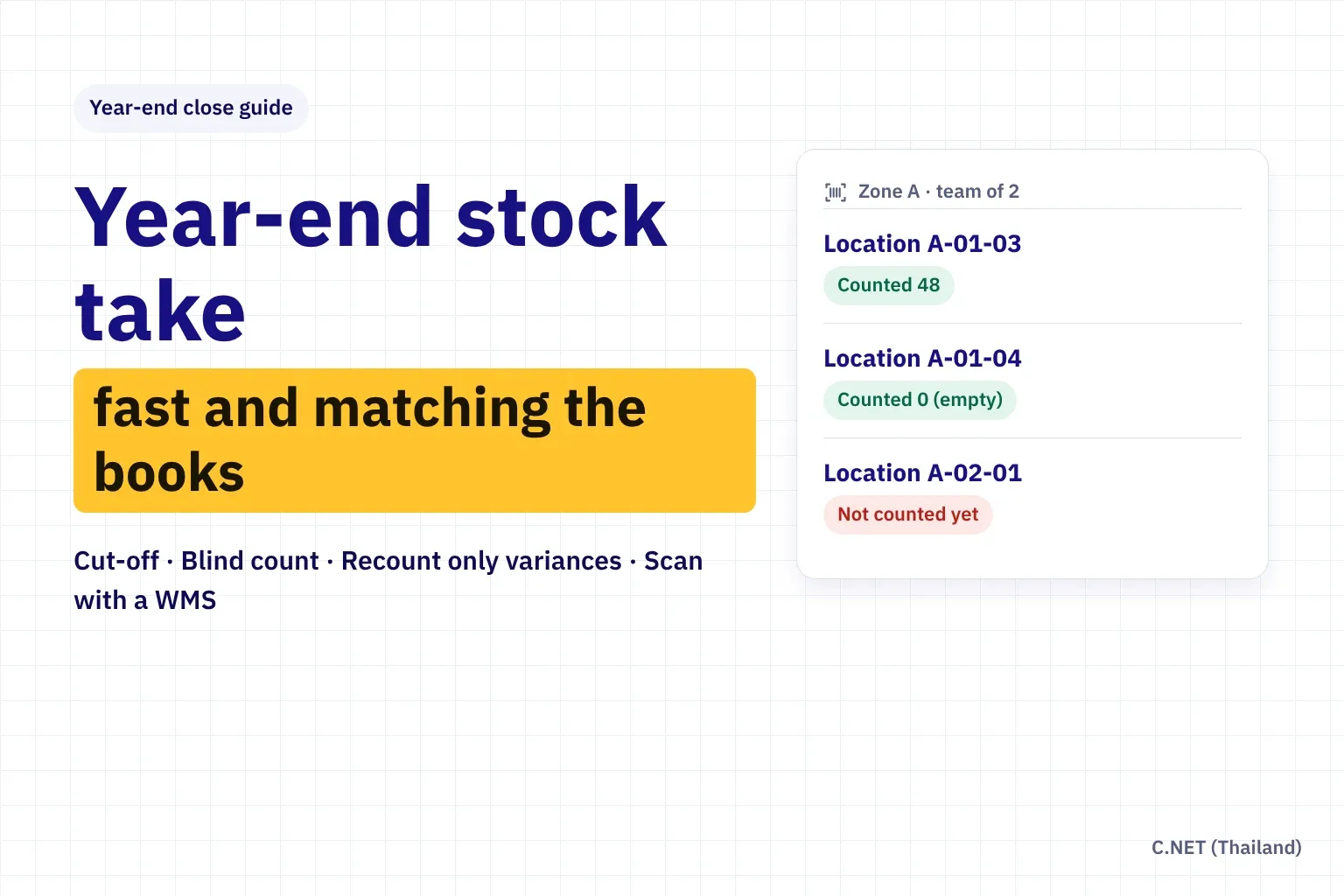
Short answer: a year-end stock take finishes fast and matches the books when all three stages are done. Before the count: post every pending receipt and issue, make stock easy to count, and set a cut-off time. On count day: stop receiving and shipping, count in two-person teams without seeing system quantities (blind count), and make sure every location is counted. After the count: recount only lines whose variance exceeds a threshold, find the cause, then adjust with documented approval. A WMS with barcode scanners removes count sheets and re-keying, which saves time and cuts errors.
This guide focuses on the full count at period end. For the basics of warehouse systems, see What Is a Warehouse Management System (WMS)?
- 3
- Stages to plan: before, during and after the count
- 2
- People per count team: one counts, the other records or scans and confirms
- 3 days
- Working days to record goods in the VAT goods and raw materials report in Thailand
- 0
- Unposted receipts and issues at cut-off: the target before counting starts
Why does the year-end count matter more than a routine count?
Period-end stock is the figure used to close the financial statements, calculate cost of goods sold and start the next year. If it is wrong, profit and next year's purchasing plans are wrong too. Companies whose statements are audited usually have the auditor observe the count (HCVT).
VAT-registered businesses in Thailand must also keep a goods and raw materials report under Section 87(3) of the Revenue Code, recording actual quantities received or issued within three working days (Revenue Department). The Revenue Department has ruled that when a count shows goods missing from the report and force majeure cannot be proven, the missing goods are treated as sold, with VAT and a surcharge payable (Revenue Department). An accurate count with explainable variances is therefore an accounting and tax matter, not only a warehouse task.
This article is warehouse practice, not tax advice. Where a variance has tax consequences, consult your auditor or tax adviser.
Checklist before count day (1–2 weeks ahead)
- Set the count date and cut-off time; tell sales, purchasing and customers when receiving and shipping stop
- Post all pending receipts, issues, transfers and adjustments before cut-off
- Separate stock that is not counted or counted apart: customer-owned goods, claims, damaged goods and sold goods awaiting dispatch; label them clearly
- Make the warehouse easy to count: items in their locations, readable location labels, open cartons consolidated to one per item
- Pre-count what you can, such as sealed cartons, and write the quantity on the sealing tape
- Split the warehouse into zones, assign one team per zone, and train everyone on the procedure beforehand
- Ask outside or third-party warehouses to count as of the same cut-off and send results back
- Test scanners and batteries, and back up system data before counting
These steps follow common practice, such as finishing pending data entry before the count and asking outside locations to count on the same date (AccountingTools).
Count day: how to count fast and reliably
Stop receiving and shipping; cut off in the system
Close inbound and outbound at the announced time. Any urgent receipt goes to an area that is not counted and is posted after the count.
Assign work by zone and location
Teams of two: one counts, one records or scans to confirm. Each team gets its own list of locations, and the supervisor sees which zones are done and which are not.
Count blind
Counters do not see system quantities, so they cannot count to the number. Best-practice research lists blind counting as a key factor.
Scan the location, then the item
Scan the location label first, then the item and quantity. For lot or expiry items, scan the lot too. Items without a barcode get a temporary label printed by the system.
Check completeness before closing a zone
Every location needs a count result, even an empty one (counted 0). Locations with no result are where stock goes missing most often.
The U.S. Government Accountability Office (GAO) studied private companies with accurate counts and summarised the key factors: knowledgeable counters, adequate supervision, blind counts, and complete counts with cut-off procedures (GAO).
After the count: recount, find the cause, then adjust
| Step | What to do | Example rule |
|---|---|---|
| 1. Compare | The system compares counts with system stock at cut-off | Show variances in quantity and value |
| 2. Recount | A different team recounts only lines over threshold | Over ±2% or over THB 5,000 in value (set by company policy) |
| 3. Find the cause | Check receipts and issues around cut-off, misplaced stock, wrong units | Unposted receipt, carton/piece conversion error |
| 4. Approve | An authorised person approves each adjustment with a reason | Approval levels by value |
| 5. Adjust | Post adjustments in the system and send stock to ERP/accounting | Keep the variance report and documents for the auditor |
The most common cause is cut-off: goods arrived but the receipt is not posted, or an issue is posted but the goods are still on the dock. Next comes units, such as counting cartons while the system stores pieces. With several warehouses, also check transfers still in transit. If the count date is not the period end, roll the count forward or back to the period end.
Paper count sheets vs. a WMS with scanners
| Topic | Paper sheets + Excel | WMS + scanners |
|---|---|---|
| Recording | Write on sheets, then key into Excel | Scan and results reach the system at once, no re-keying |
| Completeness | Check sheets number by number | The system shows locations without a result |
| Blind count | Print sheets without quantities | Hide system quantities from counters |
| Lots and expiry | Handwritten, easy to misread | Scan the lot from the barcode |
| Variance list | Excel formulas | The system produces variances and change history |
With a WMS, do you still need a full count? Usually yes, at least once a year, depending on accounting policy and the auditor. But with regular cycle counts during the year, the year-end count has few variances and finishes much faster.
How does ci.Himalayas/GLOBAL help with stock counts?
- Full warehouse counts and cycle counts
- Variance lists after counting, with a history of stock changes
- Location, item and lot scanning on handhelds running Windows Mobile and Android
- Stock separated by owner and warehouse, so customer-owned goods and several warehouses can be counted apart
- Stock sent to ERP or accounting by file or API
See ci.Himalayas/GLOBAL for the system, and Setting up FEFO in a WMS for items with expiry dates.
FAQ: year-end stock take
How is a stock take different from a cycle count?
A stock take counts the whole warehouse at once, usually once a year at period end. A cycle count counts part of the stock on a rotating schedule during the year without stopping the whole warehouse. The two work together.
What is a blind count?
Counting without seeing the system quantity. Counters record what they actually find, which stops them counting to the number they see.
What is cut-off and why does it matter?
The time at which receipts and issues are frozen before counting. Everything before it must be posted, and goods moved after it are kept out of the count. Many post-count variances come from poor cut-off.
How long must the warehouse stop?
It depends on locations and items. A well-prepared warehouse using scanners often finishes in one day, or counts zone by zone outside working hours.
What if stock is short after the count?
Recount, find the cause and keep evidence before an authorised adjustment. For VAT-registered businesses in Thailand, shortages against the goods and raw materials report may have tax consequences; consult your auditor.
Should customer-owned goods be counted?
Count and record them separately from company stock. They are not company assets, but the company is responsible for the quantity it holds.
Sources
- Thai Revenue Department: VAT, goods and raw materials report (Section 87(3))
- Thai Revenue Department: VAT, goods missing from the goods and raw materials report
- U.S. GAO (2002), Best Practices in Achieving Consistent, Accurate Physical Counts of Inventory
- AccountingTools, Inventory count procedure
- HCVT (2025), Ten Steps to Optimize Your Year-End Inventory Counts
Updated November 2026 by the C NET (Thailand) team · Recount thresholds in the table are examples; set them by company accounting policy.