Setting Up FEFO in a WMS That Works: Minimum Remaining Shelf Life (MRSL) per Customer, Quarantined Lots and the Exceptions You Need
FEFO ships the lot that expires first, but in a real warehouse that is not enough. Each customer sets a different minimum remaining shelf life, some lots are still waiting for QC, and some retailers refuse a lot older than the last one they received. This guide explains how to set FEFO + MRSL rules in a WMS, from receiving to lot allocation, with Japan's one-third rule as an example.
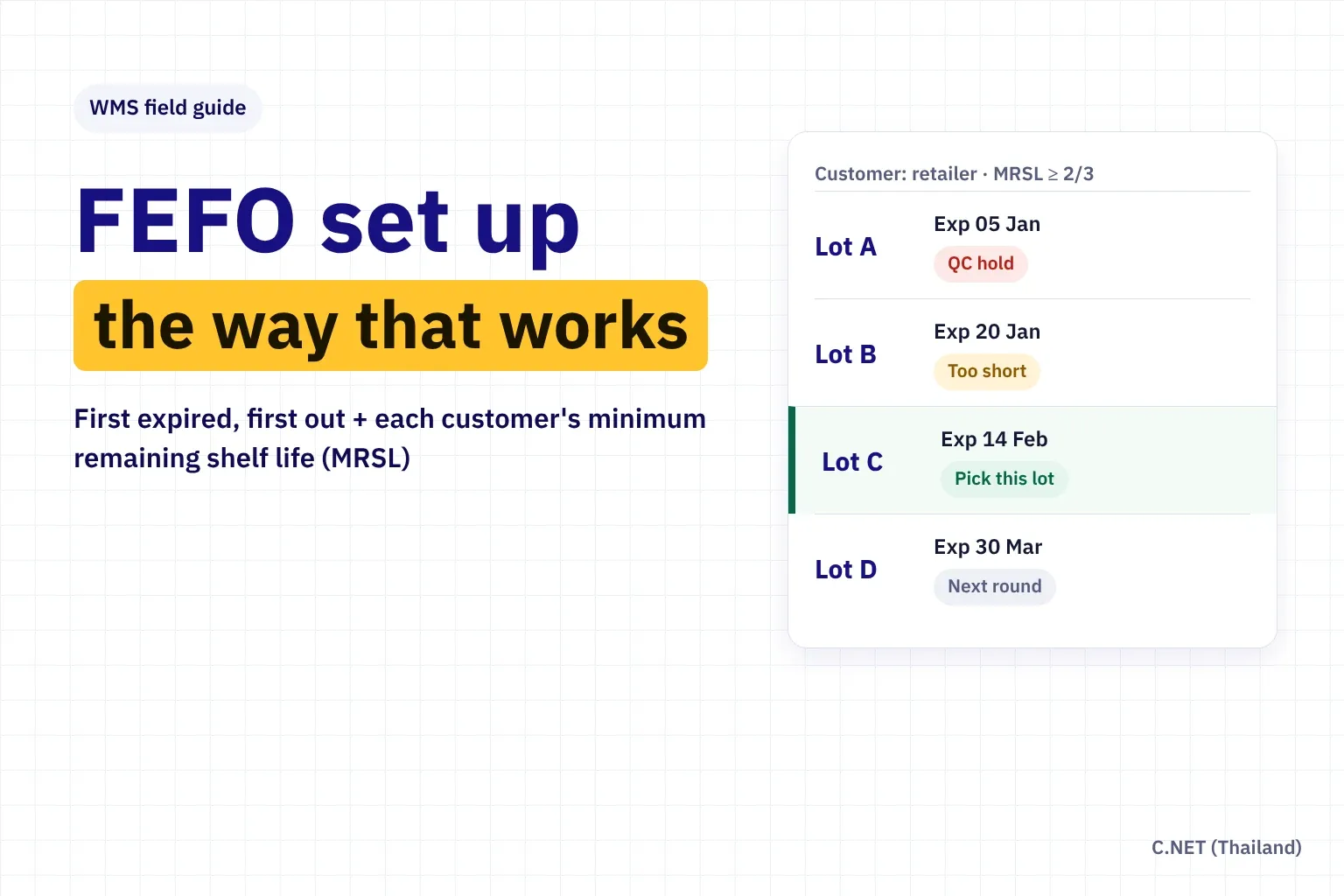
Short answer: FEFO (First Expired, First Out) ships the lot that expires soonest. A WMS that works in practice checks three more conditions before it picks a lot: 1) is the lot available to ship (not on QC hold or damaged), 2) does its remaining shelf life meet this customer's minimum (Minimum Remaining Shelf Life, MRSL), and 3) is it no older than the last lot this customer received (when the customer requires it). Among the lots that pass, the system picks the one that expires first.
For the basics of what a WMS does, see What Is a Warehouse Management System (WMS)? This article goes one step further: how to set FEFO rules so customers do not reject deliveries and expired stock does not pile up.
- 1/3
- Japan's delivery rule: food must reach the retailer within the first third of its shelf life
- 1/2
- The deadline Japan's Ministry of Agriculture (MAFF) is pushing for, to cut food loss
- (17)
- GS1 identifier for expiration date in a barcode; (15) is best before, (10) is the lot
- 3
- Checks before FEFO picks a lot: status, remaining shelf life and date order
Why is FEFO alone not enough in a real warehouse?
“First expired, first out” works when every customer accepts the same stock. Real operations are not like that. Food, beverage, cosmetics and pharmaceutical warehouses run into four common problems:
- The customer rejects the delivery because the remaining shelf life is shorter than the contract allows, even though the system picked correctly by FEFO
- A lot still waiting for quality control (QC) or under recall is picked and shipped, because the system only looks at the expiry date
- A lot with an earlier expiry date than the last one the customer received is shipped; some retailers refuse it because dates on their shelf would go backwards
- Items carry both a production date and an expiry date, but only one is recorded, so remaining shelf life is calculated wrongly
Rule of thumb: FEFO tells you which lot to pick first; MRSL tells you which lots this customer can receive. A good system uses both at once.
What is minimum remaining shelf life (MRSL)?
MRSL (Minimum Remaining Shelf Life) is the number of days, or the share of total shelf life, that must remain on the day the goods reach the customer, for example “at least 120 days” or “at least two-thirds of total shelf life”. Each receiver tends to set a different figure: retailers are usually the strictest, wholesalers and food service more relaxed, and exports may follow the destination's own rules.
The clearest example comes from Japan's one-third rule: makers or wholesalers must deliver to retailers within the first third of a product's shelf life, and retailers sell it only for the first two-thirds (World Economic Forum). Japan's Ministry of Agriculture, Forestry and Fisheries (MAFF) illustrates a product with a six-month shelf life: the one-third rule gives two months to deliver, and MAFF is promoting a relaxed one-half deadline of three months to reduce stock that misses the window and is thrown away (MAFF). Japan's Consumer Affairs Agency describes the same change as a way to reduce unshipped disposal by manufacturers (Consumer Affairs Agency).
| Rule type | Example | Suits |
|---|---|---|
| Minimum days | At least 90 days remaining on delivery | Items whose lots all have similar shelf lives |
| Share of total shelf life | At least 2/3 remaining (one-third rule style) | Ranges where shelf lives differ widely |
| Per customer or channel | Retail 2/3 · wholesale 1/2 · food service 30 days | Manufacturers and 3PLs shipping to many channels |
| No date reversal | No older than the latest lot this customer received | Retailers that arrange shelves by date |
Date reversal is not a small issue. MAFF lists the retail practice of refusing goods with an earlier best-before date than goods already received as one cause of business food loss (MAFF). If the warehouse does not keep a record of which lot went to which customer, it cannot check this condition at all.
How does a WMS allocate lots with FEFO + MRSL?
Filter status: keep only available lots
Exclude lots on QC hold, under recall, damaged or already expired. They must never be allocated, even if they expire soonest.
Calculate remaining shelf life on arrival
Use the delivery date, not the pick date. If transport takes three days, subtract three more days. Long-haul and export orders need a larger margin.
Compare with the receiver's MRSL
Take the rule from the customer or destination master data, or the item's default if none is set. A lot that falls short is not offered to this customer, but can still go to a customer with a lower threshold.
Check date reversal (if required)
Compare with the expiry of the latest lot shipped to this customer. The system needs lot-level shipment history.
Sort by FEFO and create the pick list
From the lots that pass, take the earliest expiry first. If the customer wants a single lot per line, look for one lot with enough quantity before splitting. Pickers scan the lot on a handheld, and a wrong lot triggers an alert immediately.
Set the rules once in master data (item + customer) and let the system decide every order. That beats relying on a supervisor to remember each customer's conditions, because memory is where mistakes happen most.
Get expiry dates right at receiving: read them from GS1 barcodes
FEFO is only as accurate as the expiry dates captured at receiving. When staff type dates from the label, mistakes are easy: day and month swapped, or the Thai Buddhist year entered instead of the Gregorian year. Scanning a GS1-128 or GS1 DataMatrix barcode is more reliable, because each data field carries its own prefix called an Application Identifier (GS1 UK).
| AI | Meaning | Format |
|---|---|---|
| (01) | GTIN, global product code | 14 digits |
| (10) | Batch or lot number | Up to 20 characters |
| (11) | Production date | YYMMDD |
| (15) | Best before date | YYMMDD |
| (17) | Expiration (use by) date | YYMMDD |
For packaged food sold in Thailand, labelling falls under Ministry of Public Health Notification No. 367 (B.E. 2557 / 2014), which sets how the date is shown on the label. A WMS should therefore store both an expiry date and a best-before date, and define per item which one drives FEFO. If goods arrive without a barcode that carries the date, print an internal label at receiving and use it throughout the warehouse. For 1D and 2D barcode basics, see What Is a Barcode?
Stock statuses you must keep separate
| Status | Meaning | Can it be allocated? |
|---|---|---|
| Available | Passed receiving checks, normal shelf life | Yes, by FEFO + MRSL |
| QC hold | Waiting for lab results or import documents | No, until released |
| Near expiry | Remaining life below the item's alert threshold | Only to customers with a low enough MRSL, or with approval |
| Expired / blocked | Past expiry or under recall | No; move to disposal or return area |
| Damaged / claim | Damaged packaging or waiting for a supplier claim | No |
The key is that status is tied to the actual lot and location in the warehouse, not a mark in a spreadsheet, and that every status change records who changed it and when. That history is what GMP and ISO auditors ask for.
Exceptions that need an approval step
Good rules leave a way out for special cases, but that way out must be approved and recorded, not decided on the floor. Common cases:
Customer accepts a shorter shelf life
For example in exchange for a discount, or for immediate use. The system should let an authorised person approve per order and record the reason.
Clearing near-expiry stock
Send a near-expiry report to sales in advance so they can run a promotion or find a channel with a lower threshold before the stock becomes waste.
Single lot per order line
Some customers want one lot per line to simplify recalls. The system must look for a lot with enough quantity instead of splitting.
Export orders
The destination country or importer may require more remaining life than the domestic market, plus time for sea freight.
KPIs to track after setting FEFO rules
| KPI | How to calculate | What it tells you |
|---|---|---|
| Value of expired write-offs | Value written off due to expiry, per month | Whether FEFO and stock clearance are working |
| Rejections due to shelf life | Orders or lines refused because shelf life fell short | Whether customer MRSL data is complete and correct |
| Average remaining life at shipment | Average % of shelf life remaining on shipped goods | How fresh customers' goods are, and whether stock sits too long |
| Value of near-expiry stock | Value of stock below the alert threshold | The risk of write-offs in the near future |
How does ci.Himalayas/GLOBAL help?
ci.Himalayas/GLOBAL, the cloud WMS implemented and supported by C.NET (Thailand), has more than 210 standard functions, including lot and expiry control that applies directly here.
- Lot control with expiry dates, and allocation by FIFO or FEFO
- Blocks shipments whose expiry date does not meet each receiver's conditions
- Near-expiry alerts, plus lists of expired stock and stock past its ship-by limit
- Lot scanning on handhelds running both Windows Mobile and Android, with an immediate alert on a wrong lot
- Works in cold storage, with movement history that shows which lot went to whom
To see how the system can be used as standard or customised item by item, read ci.Himalayas/GLOBAL: standard or customised.
FAQ: FEFO and minimum remaining shelf life
What is FEFO?
FEFO stands for First Expired, First Out: the lot that expires soonest is shipped first, regardless of when it was received. It suits food, beverages, pharmaceuticals and cosmetics with expiry dates.
What is MRSL?
Minimum Remaining Shelf Life is the shelf life that must remain when goods reach the customer. It can be set in days, such as at least 90 days, or as a share, such as at least two-thirds of total shelf life.
What is Japan's one-third rule?
A Japanese food industry practice where makers or wholesalers must deliver to retailers within the first third of shelf life, and retailers sell only for the first two-thirds. Japan's Ministry of Agriculture is promoting a relaxed one-half deadline to reduce food loss.
Should FEFO use the expiry date or the best-before date?
It depends on the item and what is printed on the label. The system should store both and define per item which one to use. In GS1 barcodes, expiration date is AI (17) and best before is AI (15).
Will a lot waiting for QC be picked?
It should not. The system must keep QC hold separate from available stock and never allocate that lot until it is released, even if it expires first.
Can Excel handle FEFO + MRSL?
In a small warehouse with few items and customers, yes. With hundreds of lots and many customers with different rules, checking every order by hand becomes error-prone. A WMS selects the lot and enforces a scan at picking.
Sources
- Ministry of Agriculture, Forestry and Fisheries of Japan (MAFF): business food loss measures, relaxing the delivery deadline from 1/3 to 1/2
- Consumer Affairs Agency, Japan (2020), To solve food loss and waste issues
- World Economic Forum (2023), Reducing food loss: the one-third rule in Japan
- GS1 UK, Application Identifiers: batch, best before (15) and expiration date (17)
- Thai FDA, Ministry of Public Health Notification No. 367 (2014) on labelling of packaged food
Updated November 2026 by the C NET (Thailand) team · MRSL figures in the tables are examples; actual rules depend on each customer's contract.